Publications
My scholarly interests include legal reasoning, artificial intelligence and the law, the law of democracy, and civil rights. My published writings are listed below.
The Pedagogy of Legal Synthesis, 64 Duquesne Law Review 74 (2026)
Abstract | Full Text
The ability to synthesize implicit legal principles from many ambiguous cases is a mark of a skilled attorney. But legal synthesis is notoriously challenging to teach, and law students typically receive little explicit guidance on how to synthesize. The literature likewise offers law professors little direction on how to impart the skill successfully.
This article serves as a guide for professors to effectively train law students to synthesize implicit legal principles. Drawing upon cognitive science, the study of logic, and educational research, this article explains the challenges of learning legal synthesis and equips professors with pedagogical methods and curricular resources to meet those challenges. It walks professors through how to design synthesis-friendly legal writing assignments as a primary vehicle to teach students the skill. It also explains how to lecture clearly about each aspect of synthesis, including how to use inductive reasoning, abstract implicit legal principles from ambiguous cases, and draft clear analyses. Finally, it shows how to drill the skill in class through practice exercises. The article is written with first-year legal writing professors in mind, and the tools it offers can easily be adapted for use in other courses. Armed with proven teaching techniques, law professors can empower students to master the skill of legal synthesis.
Teaching Courageous Oral Advocacy, AALS Section on Legal Writing, Reasoning, and Research 2024 Spring/Summer Newsletter 15, American Association of Law Schools (2024)
Abstract | Full Text
This piece offers insights into how legal writing professors can successfully teach students to overcome their fears of public speaking and become courageous oral advocates.
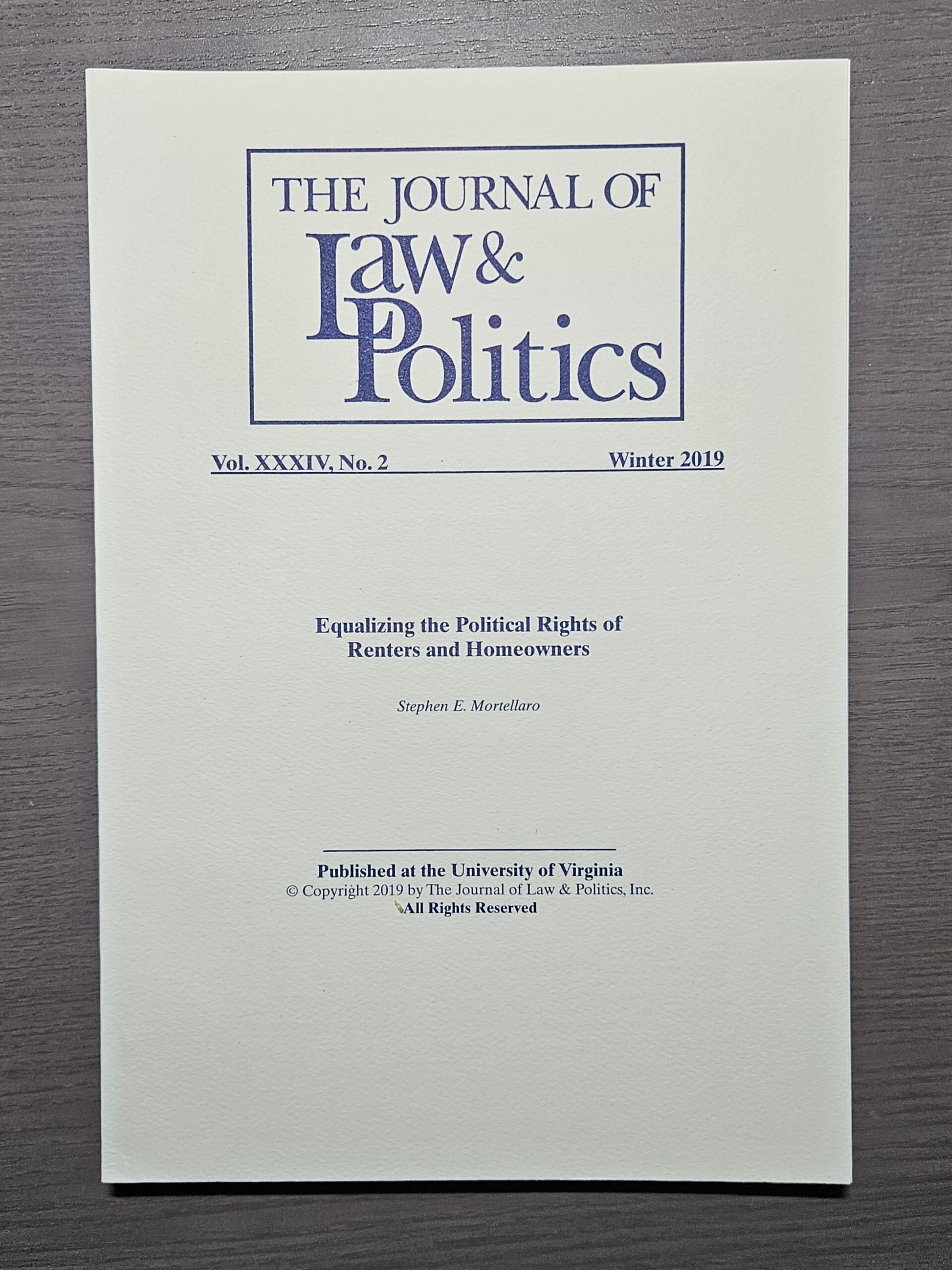
Equalizing the Political Rights of Renters and Homeowners, 34 Journal of Law & Politics 165 (2019)
Abstract | Full Text
The promise of democracy has not been kept to renters. The First Amendment protects renters and homeowners alike from governmental speech suppression, but neither landlord-tenant law nor civil rights law secures renters’ political rights from landlord interference. Landlords wield enormous power to censor what renters say, limit who they say it with, and even control what they hear — and renters rarely have legal recourse when landlords choose to exercise this power.
This article analyzes the diminished political rights of renters and proposes new legislation to put renters and homeowners on equal ground. Rather than importing wholesale from First Amendment doctrine or elevating “political ideology” to a protected status, legislatures should enact a Renters Bill of Political Rights that protects renters — and those who wish to speak to renters — from landlord retaliation for their political activities. This approach is the most compatible with existing landlord-tenant law and avoids being underinclusive and overinclusive in the rights it protects. Above all, it enables renters to participate in American democracy without fear that they will lose their home.
The Unconstitutionality of the Federal Ban on Noncitizen Voting and Congressionally-Imposed Voter Qualifications, 63 Loyola Law Review 447 (2017)
Abstract | Full Text
Congress strikes at the core of state sovereignty when it disenfranchises voters. Yet demands for national disenfranchisement laws have become pervasive since the 2016 election, and Congress has a ready model: a federal statute prohibiting noncitizens from voting in federal elections. Despite upending centuries of state control over voter qualifications, this statute remains unchallenged in court and unexamined in academia; its constitutionality has been assumed. This article challenges this assumption, arguing that the federal ban on noncitizen voting—along with every other voter qualification Congress may impose—unconstitutionally infringes state sovereignty.
Most voting rights scholarship focuses on the constitutional amendments that prevent disenfranchisement based on race, sex, wealth, and age. This article demonstrates how the Constitution limits the federal government even further. By tracing the history of the Elections Clause and analyzing contemporary election law jurisprudence, this article shows how Congress’s traditional sources of authority over federal elections do not empower it to impose substantive qualifications on voters. More fundamentally, examination of the text and history of the Voter Qualifications Clauses reveals that states possess an exclusive power to determine who is ineligible to vote. This analysis makes evident that all congressionally-imposed voter qualifications—even those that do not invidiously discriminate—cannot survive the constraints of American federalism.
(with Michelle Kanter Cohen) Restricting Voter Registration Drives, Project Vote (2014)
Abstract | Full Text
This piece analyzes the patchwork of legal restrictions on voter registration drives throughout the United States.
Revealing Evidence of Who Votes—and Who Doesn’t—in Local Elections, FairVote (Sept. 27, 2012)
Abstract | Full Text
This piece analyzes the results of voter exit poll I conducted on behalf of FairVote for a local election in Takoma Park, Maryland.